
Free · no sign-up · formulas shown

TDEE Calculator: find your real maintenance calories

Your total daily energy expenditure in seconds, with your BMR, a calorie target for your goal and daily macros. Same math as the TDEECalc app, checked against the original research.

  • Mifflin–St Jeor, Katch–McArdle & Cunningham
  • Runs in your browser
  • Shareable result link

Calculate your TDEE

Units
Sex
yrs
kg
lb
cm
Height
ft
in
Not sure? Most people with a desk job who train 3–4×/week are Light to Moderate. See the steps guide below.
Goal
Pace
Formula & body fat (optional)
BMR formula
%
Needed for Katch–McArdle and Cunningham, which use lean mass instead of weight.
Maintenance (TDEE)2,239kcal/dayBMR 1,444 kcal × activity 1.55
Fat-loss target
1,903kcal
-15% · ≈ 0.7 lb/week
BMI
27.5
Ideal wt 127 lb
Protein
167g
35%
Carbs
167g
35%
Fat
63g
30%
Activity levelTDEE
Sedentary ×1.21,733
Light ×1.3751,986
Moderate ×1.552,239
Active ×1.7252,491
Athlete ×1.92,744

Estimates from the Mifflin–St Jeor equation. Real needs vary by about ±10%. Track your weight for 2–4 weeks to find your true number.

Quick answer

Your TDEE is your BMR multiplied by an activity factor between 1.2 and 1.9. For a 35-year-old woman, 5′5″ (165 cm), 165 lb (75 kg), moderately active, that's about 2,239 kcal/day (BMR 1,444 × 1.55). Eat around that to maintain your weight, roughly 10–20% less to lose fat, or 5–15% more to build muscle.

What is TDEE?

Total daily energy expenditure (TDEE) is the number of calories your body burns in a full day. It's the sum of four parts, and only the first is fixed:

Where the example's 2,239 kcal goes. Activity includes exercise and NEAT (everyday movement). TEF ≈ 10% of intake.
  • Basal metabolic rate (BMR), 60–70%: the energy to stay alive at rest. Calculate your BMR.
  • Non-exercise activity (NEAT): walking, standing, fidgeting and chores. It is the most variable part of TDEE and can differ by hundreds of calories a day between people of similar size (Levine, 2002).
  • Exercise: usually a smaller share than people expect, typically 5–10% of TDEE.
  • Thermic effect of food (TEF): about 10% of what you eat goes into digesting it, and more for protein (Westerterp, 2004).

How this TDEE calculator works

The calculator runs two steps, the same way the TDEECalc app does:

  1. Estimate BMR with the Mifflin–St Jeor equation, which a systematic review found to be the most accurate everyday equation for healthy adults (Mifflin et al., 1990; Frankenfield et al., 2005). If you add body fat, you can switch to Katch–McArdle or Cunningham.
  2. Multiply by an activity factor to scale resting energy up to your whole day.
TDEE = BMR × activity factor BMR (women) = 10 × kg + 6.25 × cm − 5 × age − 161 BMR (men) = 10 × kg + 6.25 × cm − 5 × age + 5

From TDEE it sets a calorie target for your goal (−10/−15/−20% to lose, +5/+10/+15% to gain) and splits it into protein, carbs and fat. See the full methodology.

TDEE activity multipliers

Activity levelWhat it looks likeMultiplierExample TDEE
SedentaryDesk job, little or no exercise×1.21,733
LightLight exercise 1–3 days/week×1.3751,986
ModerateModerate exercise 3–5 days/week×1.552,239
ActiveHard exercise 6–7 days/week×1.7252,491
AthleteTwice daily training or physical job×1.92,744

Step counts help too. Researchers classify under 5,000 steps a day as sedentary, 5,000–7,499 as low active, 7,500–9,999 as somewhat active and 10,000 or more as active (Tudor-Locke et al., 2011). Those bands line up roughly with the Sedentary, Light, Moderate and Active levels here. Our steps to calories calculator converts your steps directly.

TDEE for weight loss, maintenance and muscle gain

GoalAdjustmentExample targetExpected pace
Lose (faster)−20%1,791≈ 0.9 lb/week at first
Lose (moderate)−15%1,903≈ 0.7 lb/week at first
Lose (gentle)−10%2,015≈ 0.4 lb/week at first
Maintain0%2,239Stable weight
Gain (lean bulk)+5–10%2,351–2,463≈ 0.25–0.5% of body weight/month

Weight loss slows over time because a lighter body burns less. The old "3,500 calories = 1 pound" rule ignores this and overpredicts long-term loss (Hall et al., 2011). Our weight loss calculator recalculates TDEE week by week instead.

Beyond the estimate

Calculators guess. Your weight trend knows.

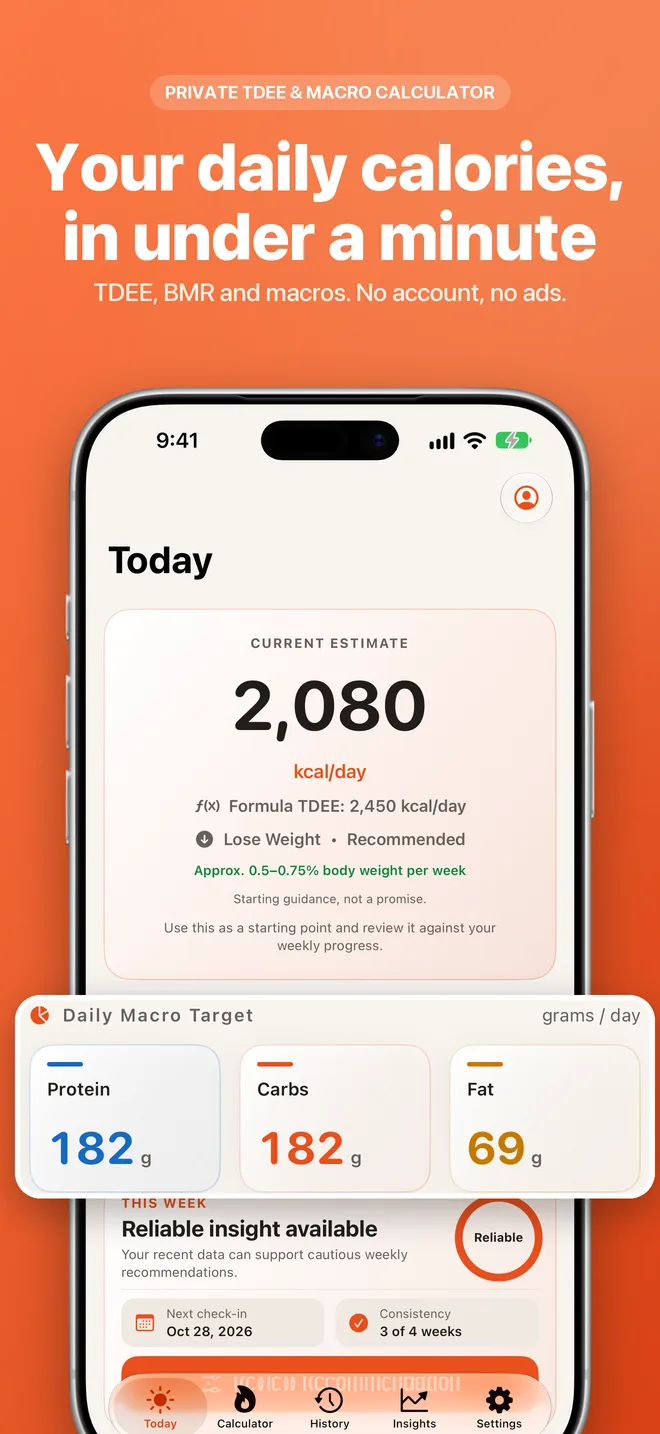
Every TDEE formula is an average. After a few weeks, your own data is better. If you ate 1,900 kcal a day and your trend weight fell 0.4 kg a week, your real TDEE is about 2,340 kcal. That's adaptive TDEE.

  • Smooths daily water swings into a trend line
  • Learns your real maintenance from intake + weight
  • Private: everything stays on your iPhone
Free tools

More calculators

All calculators
Learn

Guides that answer the next question

Frequently asked questions

What is TDEE?

TDEE stands for total daily energy expenditure: every calorie you burn in 24 hours. It adds your basal metabolic rate (BMR) to the energy used by daily movement, exercise and digesting food. Eating at your TDEE keeps your weight stable.

How do I calculate my TDEE?

Estimate your BMR with the Mifflin–St Jeor equation (10 × weight in kg + 6.25 × height in cm − 5 × age, +5 for men or −161 for women), then multiply by an activity factor from 1.2 (sedentary) to 1.9 (very active). This calculator does both steps instantly.

How accurate is a TDEE calculator?

Equations estimate the average for people of your size, age and sex. For most people the result lands within about 10% of their true expenditure, so 2,200 kcal could really be 2,000–2,400. Logging your weight and intake for 2–4 weeks reveals your actual number — see how accurate TDEE calculators are.

Which activity level should I choose?

Pick the level that matches your whole day, not just workouts. A desk job with 3–5 workouts a week is usually Light to Moderate. If you're unsure, choose the lower level: overestimating activity is the most common reason calculated targets don't work.

How many calories below my TDEE should I eat to lose weight?

A 10–20% deficit is a sustainable range for most people, which works out to roughly 0.5–1% of body weight per week. Larger deficits speed up early loss but make it harder to keep muscle and stick with the plan. Use the calorie deficit calculator to see a goal date.

Is TDEE the same as maintenance calories?

Yes. Your maintenance calories are your TDEE: the intake at which your weight stays the same over time. Day-to-day water swings make it look like it moves, which is why it's best judged from a multi-week weight trend. The maintenance calorie calculator is set up for exactly that goal.

Why isn't my TDEE changing when I lose weight?

It is, just slowly. A lighter body burns less, so every kilogram lost lowers TDEE by roughly 10–20 kcal/day, and activity often drops unconsciously too. Recalculate after every 4–5 kg (10 lb) lost, or use an adaptive method that updates automatically.

Is this TDEE calculator free and private?

Yes. It runs entirely in your browser, needs no account and stores nothing on a server. The TDEECalc iPhone app works the same way: your data stays on your device.

References

  1. Mifflin MD, St Jeor ST, Hill LA, Scott BJ, Daugherty SA, Koh YO (1990). A new predictive equation for resting energy expenditure in healthy individuals. American Journal of Clinical Nutrition 51(2):241–247.
  2. Frankenfield D, Roth-Yousey L, Compher C (2005). Comparison of predictive equations for resting metabolic rate in healthy nonobese and obese adults: a systematic review. Journal of the American Dietetic Association 105(5):775–789.
  3. Levine JA (2002). Non-exercise activity thermogenesis (NEAT). Best Practice & Research Clinical Endocrinology & Metabolism 16(4):679–702.
  4. Westerterp KR (2004). Diet induced thermogenesis. Nutrition & Metabolism 1:5.
  5. Tudor-Locke C, Craig CL, Brown WJ, et al. (2011). How many steps/day are enough? For adults. International Journal of Behavioral Nutrition and Physical Activity 8:79.
  6. Hall KD, Sacks G, Chandramohan D, et al. (2011). Quantification of the effect of energy imbalance on bodyweight. The Lancet 378(9793):826–837.